Comment

How to introduce cats and dogs

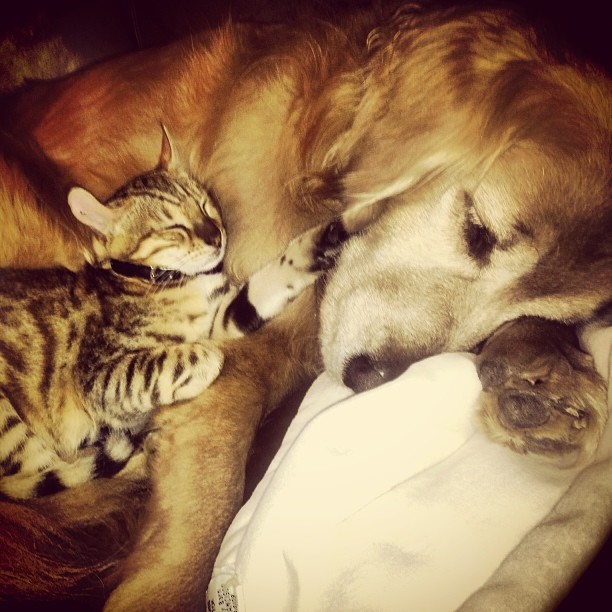
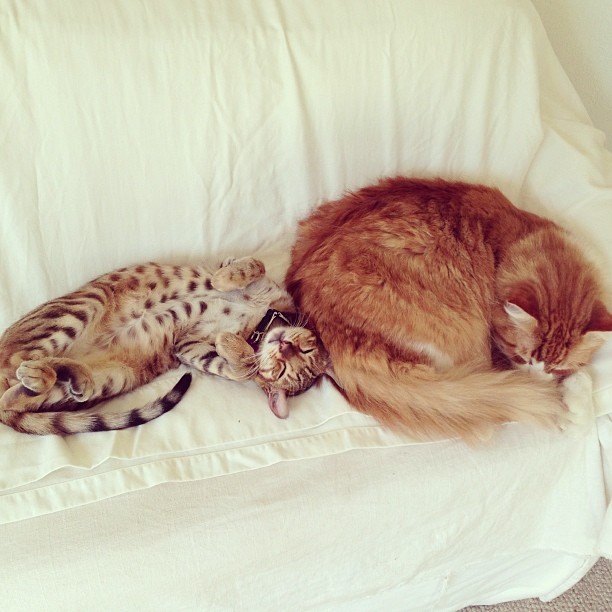
There's nothing cuter than interspecies relationships and I personally melt into a puddle when I find my cats and dogs cuddling together. The absolute best is when I'm on the couch and I invite my dog, Daisy to jump up next to me and suddenly I'll find myself in the middle of a giant cuddle puddle of sweetness. Our kitten Tiger loves to cuddle up in Daisy's fluffy tail or right up against her belly in a little ball. Then Bear, our big orange fluffy cat will come over and lay right on top of me. Taj isn't into cuddling with cats and likes to pretend they don't exist, so he will come over and lay on my feet. I don't think there's anything else in my life that makes me feel so fuzzy and happy inside than when my animals choose to all come over and snuggle with me. One of my friends saw a photo of all of my animals together and said that it's the picture of harmony. I couldn't have described it better myself. 69534_10102125426949184_415270151_n
However, things weren't always so harmonious. Daisy has a pretty high prey drive for small , fast moving animals, aka kittens, so introducing a new family member had to be done very slowly and carefully. The more time and patience you put into introducing your dogs to a new cat or vice versa, the more successful the outcome. When we brought Tiger our new kitten home, we kept her in our bedroom for about a week. For the first few days, I let Daisy and Taj get to know her scent just by playing with Tiger and then letting the dogs smell me. I did not let the dogs see her or be in the same room with her for about three days. I wanted to "newness" of Tiger being in the house to wear off and I wanted Tiger to feel comfortable in her new home without feeling like some big monsters were going to barrel into the room and chase her under the bed. The first three days were crucial for our bonding time so that she could learn to trust me. I also made sure to give the dogs plenty of normal attention and play time.

After three days of playing it cool, I decided to bring the dogs into the bedroom on-leash one by one. With Daisy on leash, I used a clicker and lots of small-sized, smelly treats to reward her every time that she decided to look at me instead of the kitten. Then I asked her to stay in a down and continued to reward her for keeping her attention on me. It's important to keep everyone calm during this process and to keep the leash very relaxed. I also don't recommend holding the kitten or cat because they will feel trapped and even more fearful of the dog. After a day or two of several of these types of sessions, I dropped the leash and clicked/treated way less. I only clicked/treated when Tiger would make sudden movements or would get really close to Daisy to check her out. Around day five, I would let both dogs in the room with us at a time and then by day six everyone was well acquainted. By the end of the week, the dogs were intrigued, but completely welcoming and relaxed around the new kitten. Tiger was also feeling much more comfortable in her new surroundings (and successfully using the litter box!) so I decided to let her explore the rest of the house. While Tiger was dashing around and checking out every corner of her new playground, I did a few trick and treat sessions with Daisy and Taj to keep their attention on me and create a positive association with the new kitty in the house. Daisy and Taj were familiar with our cat Bear, making the process a lot easier, so if you're introducing your dog to a new cat here are some more pointers...
1618605_10102138719620564_499973229_n

1) Work with your dog on basic obedience commands before you bring home your new cat. Especially work on sit-stays, down-stays, leave-it, staying calm with distractions and keeping attention on you.

2) Create a safe space for your new kitty. Introduce your cat and dog slowly. Don't overwhelm either of them and make sure they have spaces to get away from each other. You can also use an exercise pen if you don't feel like you have enough control of your dog on a loose leash. Sit with your dog inside of the pen while clicking/treating for good attention on you, while your cat hangs out in the room.

3) Judge your dog's reactivity. If your dog is intensely staring at your cat, stiffly wagging his tail, has a tense body and will not give you any attention while you call his name or make the kissy noise, your dog is still in a high prey drive mode and not ready to freely interact with your cat. If your dog can relax in the presence of  the cat- low wagging tail, comfortably lying down, soft eyes, soft ears and able to give you attention at anytime- you may be able to move onto the next step of dropping the leash. Just go slow and do what you feel most comfortable with. If your dog has a severe prey drive, you may second guess bringing a cat into your home, or be willing to work really hard with attention clicker/treating exercises.

4) Use baby gates in your home to block off a room or two so that if your dog does try to chase your cat at some point, the kitty can jump the gates to safety. Also, make sure that your cat's food is up high and that your cat can't get to your dog's food or bother him while he's eating.

5) Give your dog lots of love, attention, exercise and play time even though you may be excited about hanging out with your new kitty. Dogs can get jealous and feel left out.

1604468_10102172083633814_69287079_n

We've had Tiger as part of our family now for almost three months and we couldn't be happier with how well everyone is getting along. Even Bear, our older cat loves her and they chase each other around the house all day long. They stop for several cat naps and then they're at it again. To see Tiger cuddled up with Daisy just gets me every time. I've always considered myself a dog girl, but now I'm definitely a crazy cat lady too!

Comment

Comment

How to walk yourself on a leash.

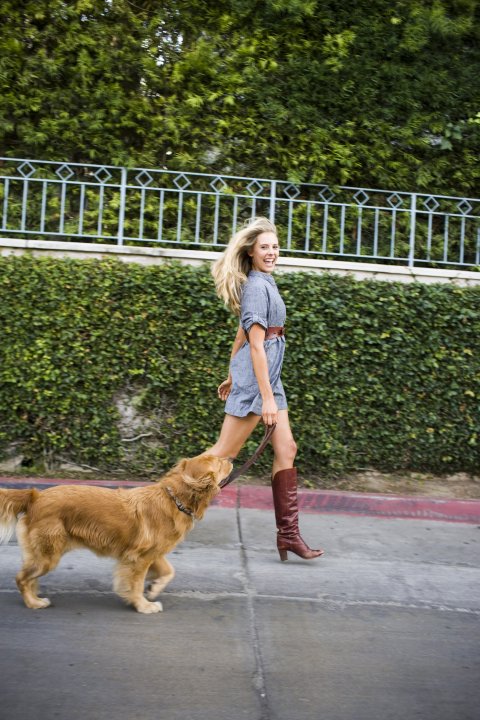
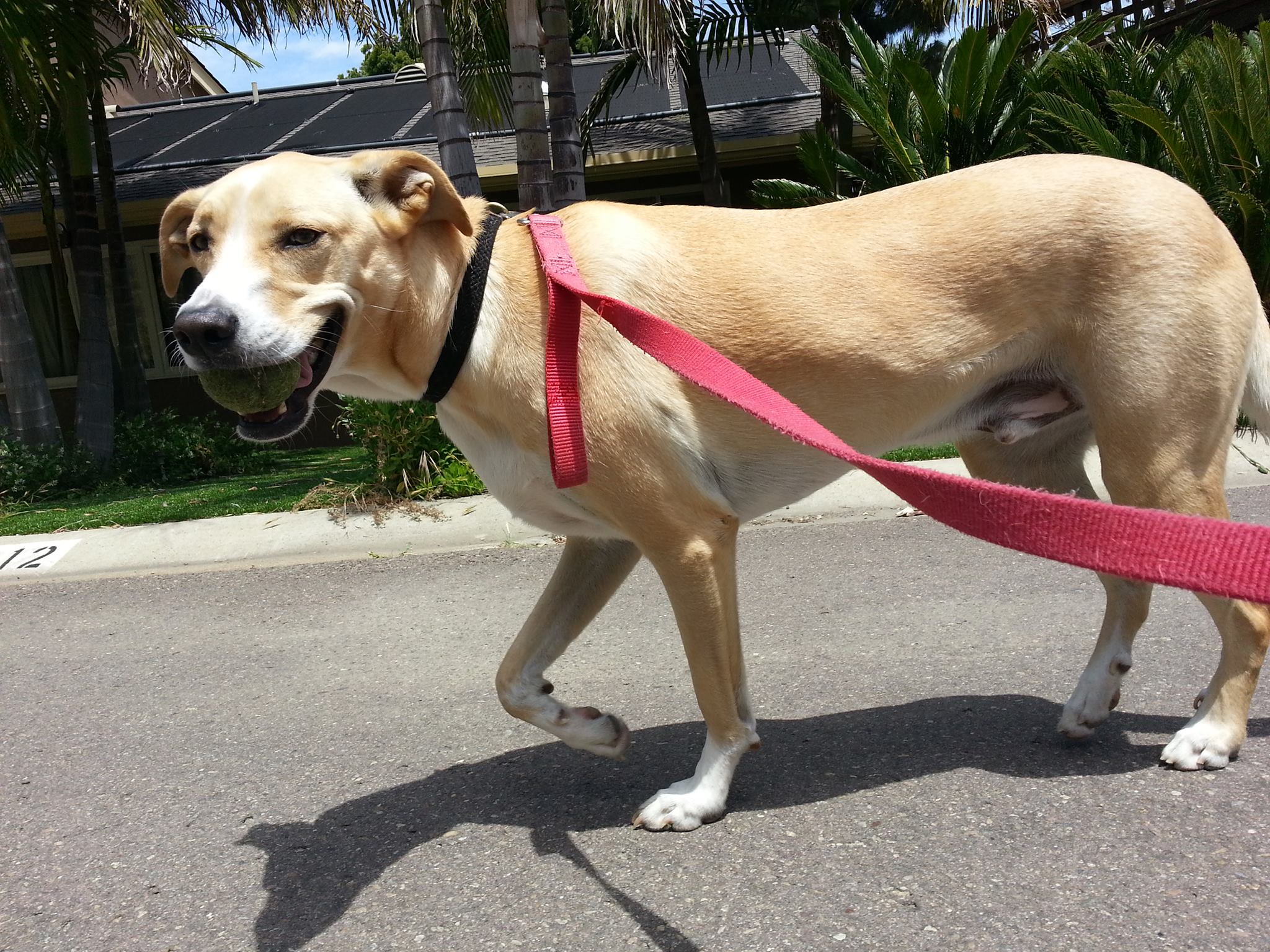
A collar and leash on a dog seems so natural and most people wouldn't think twice about just throwing a collar on a puppy and pulling them out the door on a leash. However, it's important to remember that a collar and leash is far from natural for a dog to wear. Take both of your hands right now and tighten it around your neck, then try to push your head forward against your hands as if pulling against a leash. Notice how a little panic starts to set in when you feel like you can't breathe. Next, put a rope around your neck, or if you're really brave, a metal prong collar and a leash. Then ask a friend to lead you around wherever she wants to go. Next, walk past a bear that's on the loose, or better yet someone who's running at you with a knife and try to pull away from the leash. Not fun to be scared and choked at the same time with no where to run, eh? 334347_10150395193681397_2147061556_o

Some would say that I'm anthropomorphizing this scenario, but all I'm trying to do is put you in your dog's shoes, or paws, for a second. It makes me absolutely cringe to see people wildly yanking on leashes and dragging their dog around without proper cues or consistent directions.The key to a well behaved dog on a leash is to also be a well behaved human. Be consistent about which side you want your dog to walk on, hold the leash at the same length for walking in a heel position and let the leash out to the end when releasing your dog for a sniff and pee break. Teach your dog the heel command without a leash in your home at first by leading him around with a treat held by your side. Then introduce the leash in your home and each and every time your dog pulls, come a dead stop and wait till your dog takes the tension off and then move forward. Once your dog is understanding the concept of a loose leash and the heel command, start working outside with the same consistency and patience. Teach your dog to follow you by switching directions often. Teach your dog to give you attention when he is startled by a stimulus or when he is nervous around other dogs. Use the kissy noise, or a cue like "this way" when you want to switch directions or "wait" when you want to come to a stop.

Whatever you do, avoid a never ending game of tug-of-war and if you don't want your dog to pull on the leash, show him the same respect by not pulling on him. Think of the leash merely as a safety device, in fact, just wrap it around your waist if the habit to pull is so deeply engrained. Imagine in your head an invisible loose leash and use your signals with your voice, hands and body to convey that there is an invisible wall that extends from your side that your dog must not cross. Leave your phone at home or in your pocket when you take your dog for a walk. Majority of dogs, will take advantage of their human being distracted and will pull or lunge like crazy when their human is talking on the phone. It may take a long time to break the habit of pulling, but the proper tools, a lot of patience and a lot of understanding will have you well on the way to enjoying walks with your best friend again. We're here for you if you'd like to learn how to make walks fun again!

964576_10151655742876397_6024822_o

Comment

Comment

Recipe for Creating a Cuddly Puppy

What you’ll need: 1 tired out puppy

5 cups of love

15-30 minutes of time

1 treat pouch

1/4 cup of soft, smelly, yummy treats

1 bully stick or chew toy

Directions:

There’s nothing better than a sleepy, relaxed dog to cuddle with, but some dogs are not naturally the cuddly type. Dogs don’t hug and squeeze each other and they certainly don’t hold each other. Most dogs prefer to sleep by themselves and not in a dog pile. They definitely don’t give one another pats on the head. In order to teach your dog to be really relaxed and comfortable with being handled by everyone and anyone, it’s important to teach them to love being petted, hugged and touched all over. Taking the time to handle your puppy and teach him to be calm in someone’s lap, sit still for ear and mouth exams, and be comfortable with his paws being handled is extremely important for trips to the vet and groomer. It’s also an important way to bond with your new puppy and teaches him to be very calm when petted. A lot of dogs get overly excited when they are petted or given attention and end up jumping on people and getting out of control. By spending quiet, cuddly time with your puppy you will be positively reinforcing his calm, Zen behavior instead.

1. Make sure your puppy gets an appropriate amount of mental and physical exercise during the day. Puppies eat, poo, pee, play and crash, all day long. If you try to get your puppy to relax in your lap when he’s amped up and in the puppy crazy mode, he’s going to become mouthy and will resist the handling. Play fun games with your puppy and wear him out with a game of fetch or hide and go seek before you initiate cuddle time.

2. In a quiet place away from a lot of distractions, put your puppy in your lap or on the floor next to you. With one hand, lure him into a down with a piece of treat and while feeding the treat, pet your puppy’s back or shoulder with the other hand in a slow methodical way. Keep feeding your puppy tiny pieces of treats and slowly start to pet his legs and then start moving down towards the paws.

2. If your puppy gets uncomfortable or starts to bite your hand, stop giving treats, stop petting and remove your attention for a minute or two. Once your puppy calms down, try again and reward frequently for letting you pet more sensitive areas like his ears, paws, tail or the top of his head.

3. If your puppy is completely relaxed, floppy and enjoys being handled already, rub his belly and gently encourage him to lay on his back. A dog that is comfortable on his back is showing you that he is relaxed and totally calm and confident in you.

4. If your puppy is really mouthy, make sure that you have a bully stick or a chew toy to offer him whenever you want to pet and handle him. Whenever his is chewing on his toy and not on your hand praise him and tell him he’s a good puppy. Make sure you don’t get into a habit of letting him bite and then giving him a toy because you don’t want to accidentally reward biting behavior by giving him the toy.

5. Once your puppy is nice and relaxed, practice scooping him up in your arms and gently give him a little hug. If you doesn’t squirm, praise him and then immediately release him back onto the ground. If your puppy wiggles and starts biting your hands, make sure that you hold him so that he can’t bite your hands by gently holding him around his shoulders. Do not let go of your puppy while he is squirming, patiently wait for him to calm down and then tell him “good boy” and then release him. After a few sessions doing this, your puppy will learn that calm, floppy behavior is much more relaxing and enjoyable than resisting and struggling.

6. Just remember that dogs react to your energy level, your tone of voice and your body language. If you use an excited, high-pitched tone and “scruff” up your dog with vigorous petting, you will get him all excited and it will result in more biting. If you are calm, use a soothing low voice and pet him slowly with long or circular movements you will end up putting your puppy to sleep. Think about how nice and calming it is to get a massage and then use those same movements on your puppy. In no time your puppy will learn to absolutely love being hugged, petted and cuddled.

Below are old photos of me and Taj when he was a puppy. There’s nothing better than puppy breath and falling asleep together after a long day of fun!

ImageImageImage


Comment

Comment

How to Train Your Puppy to Heel

What you’ll need:

1 cute puppy 2 cups of love 5 cups of patience 1 Easy Walk Training Harness by Premier 6 ft Hands free leash 1 treat pouch 1 clicker 1/2 cup of soft smelly treats (cheese, chopped chicken, soft jerky treats, Zukes Mini Naturals or Ziwi Peak)

Directions:

1. Before you even clip on the leash or step outside, make sure that your puppy knows what heel means (also make sure that you know what it means!). A lot of dogs and their humans think that it means jerk on the leash and say heel whenever your puppy pulls. This only results in tug of war, frustration and a choking dog. Heel means that your puppy must stay by your side with his head lined up by your leg and his body parallel to yours. When your inside your house with no distractions lure your puppy to your side with a treat and click and feed once he is in the right position. Keep reinforcing your puppy for staying by your side in a standing position by clicking/treating. Then next step is to take a step forward and encourage your puppy to take a step forward with you. Keep your hand with the treat on the seam of your pants and when your puppy’s head is by your side click/treat. Keep doing this until you’re able to take several steps with your puppy walking right next to your side. Then take the lure away by guiding your puppy with your hand and without the treat in it. Click/treat when his head is by your side and then reach your hand into to your pouch to give him his reward.

2. Once your puppy is happily heeling by your side in the house you can attach your hands-free leash to your waist and to your dog’s front connecting harness. Ask him to sit and stay at the door and then release him with “ok!” once the door is all the way open. If his bottom pops up, close the door and repeat until he’s able to stay calmly as you open the door. Once you get outside the door ask him to sit calmly again. Ask your puppy to “look” and click/treat him for giving you attention. Then release him with an “ok, heel!” and walk off quickly in the direction you want to go.

3. When walking your puppy, pretend like you are the Queen (or King) of dogs and walk as quickly as you can. When dogs are in a trotting pace, they know that you mean business and that you’re traveling somewhere together. If you walk slowly, your dog will want to do a lot more sniffing which results in more pulling. Plus, your dog will think you’re more fun if you’re walking quickly and happily. Also, leave your phone at home! If you’re not paying attention to your puppy he will ignore you too and will want to drag you to every bush in the neighborhood to check his pee-mail.

Daisy heeling by my side and giving me her attention even though there's distractions.

4. Just like in the house, capture and reinforce your puppy’s good behavior with lots of “good heel!” and click/treats. Remember to feed right by your side near the seam of your pants. When distractions come your way, click/treat more quickly.

5. If your puppy pulls you or ignores you due to distractions, ask him to “look” or use the kissy noise to get his attention back to you. if he ignores you after two tries, quickly turn and go the other way. It will keep him on his toes and ‘reset’ the heel. If your dog lunges or pulls for something, you can also stop dead in your tracks and ‘be a tree’ until your dog calms down, stops pulling and takes the tension off his lead. A tight leash means your puppy goes nowhere and doesn’t get to check out whatever he wants to move towards. A loose leash is good and means that he gets to go towards what he wants to check out. Moving forward is a reward. Pulling equals stopping which is the consequence.

6. Be consistent and your puppy will be walking beautifully by your side in no time! Once he knows what “heel” means you can start weaning him off the treats and just use lots of praise and attention when he’s traveling by your side. Also, remember to reward your dog with “ok go ahead!” Which means he’s allowed to go out on the end of his leash and sniff and smell all the flowers and bushes that his heart desires!

Below is a quick clip of a training session with Lego today! Lego is a 4 month old adorable shepherd/lab mix puppy who is learning how to walk on a loose lead and walk nicely with distractions. This is his first time learning the heel command, therefore we are using lots of repetition and treats, but gradually we phase out the clicker and the treats to replace it with life rewards and praise. For instance, the reason why dogs want to pull is because they want to sniff and smell. So you can reward them by releasing them from your side with a "Ok! Go ahead" and allow them to go to the end of the leash to sniff, smell, explore and be a dog. They still shouldn't pull you so if your dog does, 'be a tree' and do not move until they loosen the tension on the lead and give you attention.

Lego's first leash lesson (click on the lick for a quick video demo)

Happy training!


Comment

Comment

Sit-for-Pets: The key to a polite and patient dog

Want to know the quickest, easiest way to transform you dog's behavior? Simply ask your dog to sit in front of you if he wants to be petted. Sit-for-Pets is a a very simple and easy way to teach your puppy to always approach you or another person and sit nicely to wait for attention, pets and love. The most common behavior complaints that people have about their dogs are jumping and barking for attention, but both of these can be easily fixed by asking your dog to automatically approach you and sit if they want attention. You're probably thinking, "But that's way too easy! My dog is terrible and won't stop jumping on me no matter what I do!". Remember that the key to successful dog training is to turn a negative situation into a positive one so that you're better able to communicate to your dog what you want him to do in place of the undesirable behavior. For instance, instead of saying "I hate it when my dog jumps on me," switch it to "I love it when my dog approaches me calmly and sits and waits to be petted." So the first step is to identify a solution to the problem and the next step is to execute it and extinguish the 'bad' behavior.

Dogs learn by repetition and consistency so it's very important to be mindful of your everyday interactions with your dog. By training yourself not to pet your dog absentmindedly, you will be learning to save your 'pets' for your dog's good behaviors throughout the day. I can't tell you how many people absentmindedly pet their dog whenever their dogs use 'pushy' and demanding behavior. Then they ask me why their dogs bark for attention, paw and scratch, whine etc. It's because they've been rewarding the behavior without even knowing it! People often worry about always having to use treats to get their dogs to do things. First of all, this means that you have not been successful in phasing out the food reward and second of all, this means that your dog is being spoiled and not treated. Phase out the use of food rewards by replacing the food with pets, toys or life rewards (getting the leash on, going outside, greeting another dog etc.). If you give out free pets all day long, you just might be rewarding your dog for unwanted behaviors, like pawing and begging for attention with barking. If you become mindful about only petting your dog for good behaviors, your dog's behavior will be positively reinforced all day long and not only in your training sessions.

Don't worry! This doesn't mean that you'll never be petting your dog, quite the opposite! Be prepared to pet your dog even more love throughout the day. You dog will love getting attention for being calm and polite and will be automatically sitting in front of you in no time, looking for more belly rubs and pats. If you are extremely consistent about only petting your dog when he is sitting calmly, your dog will learn how to greet you more politely when you walk in the door at the end of the day, when he comes running up to you from a full sprint, when guests come to your house and when you're out and about greeting people on the street. It all starts with you learning how to always ask your dog to sit before giving him pets.

288096_10150348014306397_5127179_o

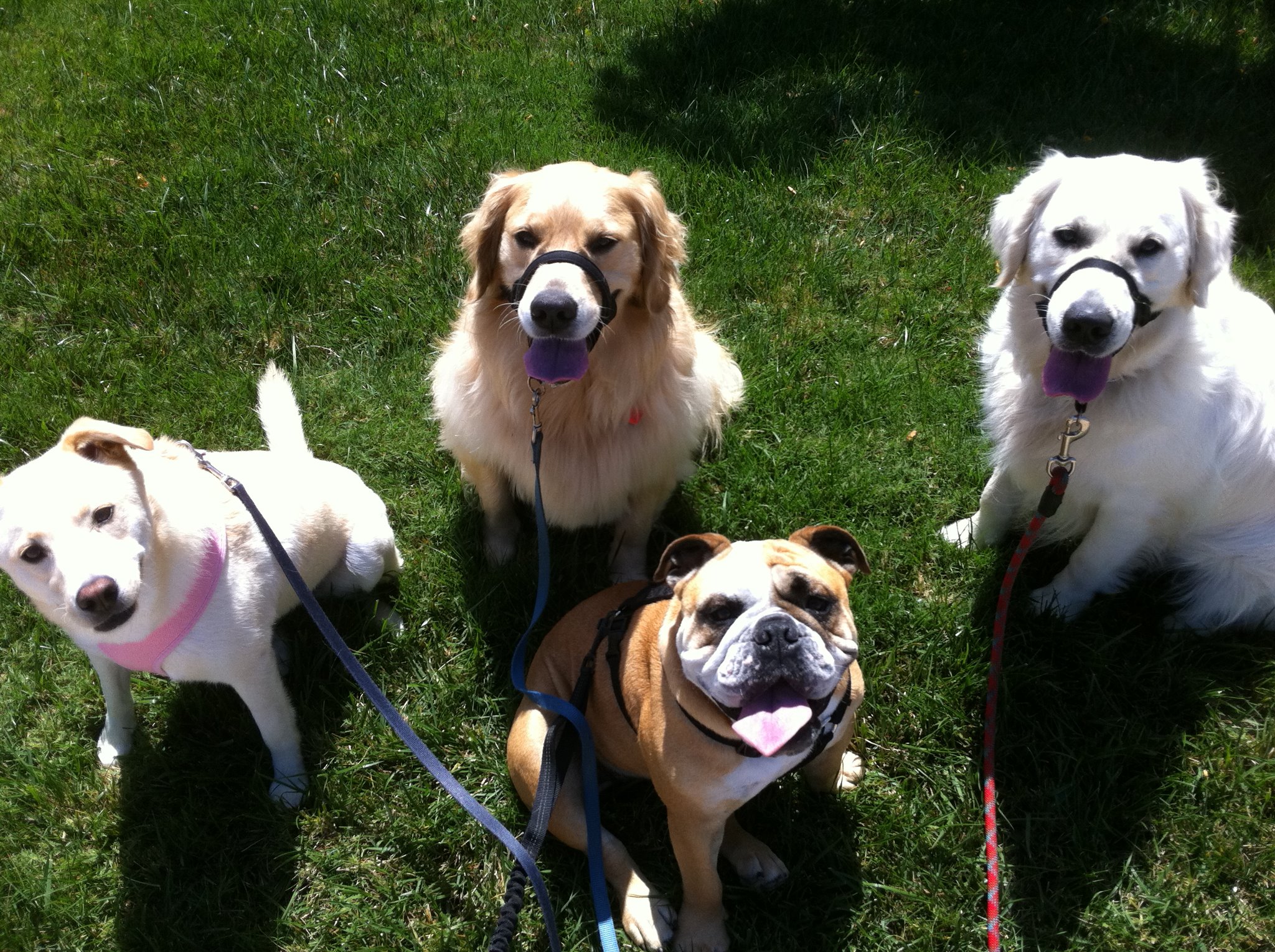
Sadie, Samantha, Bailey and Bernini showing off their Zen Sit-for-Pets skills. 

If your dog's rear end pops up the second you touch him, calmly stand up and stop petting. As soon as he sits again, start petting. If he gets up, remove your hand again, until he learns that sitting calmly with his bottom glued to the floor is the best way to be petted. Dogs who jump up and get really excited may need a lot more reinforcement in the beginning of these exercises and may need a food reward dropped on the ground by your feet as they approach you. Keeping dropping treats on the ground as he approaches so that he is thinking about keeping his paws on the floor and not on your pants. Once your dog is approaching you calmly and thinking that good things come from the ground (and not up by your hands and face- the reason why dogs want to jump up in the first place), start asking him to sit and then give a treat right to his mouth so that he is not encouraged to jump up and grab it from your hand. As he learns to sit politely, extend the amount of time that you feed the treat so that he is learning to stay seated in front of you for a longer period before he earns the treat. Once your dog knows that sitting in front of you is the only way that he will earn your rewards and attention, start using just pets.

Other exercises that you can do include backing away from your dog and then as he approaches you wait calmly for him to automatically sit. Then treat or pet and then repeat the exercise. Keep practicing moving around and freezing until your dog automatically sits in front of you before rewarding him. If your dog doesn't seem very  motivated, make your movements quick and fun so that they are following you around happily and waiting for you  to stop so that he can sit. Make it into a fun game and your dog will be politely and automatically sitting like a little gentleman in no time!

Weave Sit-for-Pets into your daily life with your dog and you will see a dramatic change in your dog's behavior and happiness. A sitting dog is a good dog and a Zen dog.

Happy Training!

Comment