
1 Comment

Should dogs be allowed on the couch and the bed?

As I write this post I'm sitting on my couch with my 80 lb. golden retriever, Taj, practically laying in my lap and my 60 lb. golden, Daisy, all snuggled up to me on my right. I must admit, one of my absolute, most favorite things to do in the whole entire world is snuggle with my favorite furballs. 340540_10150630071256397_110998373_o
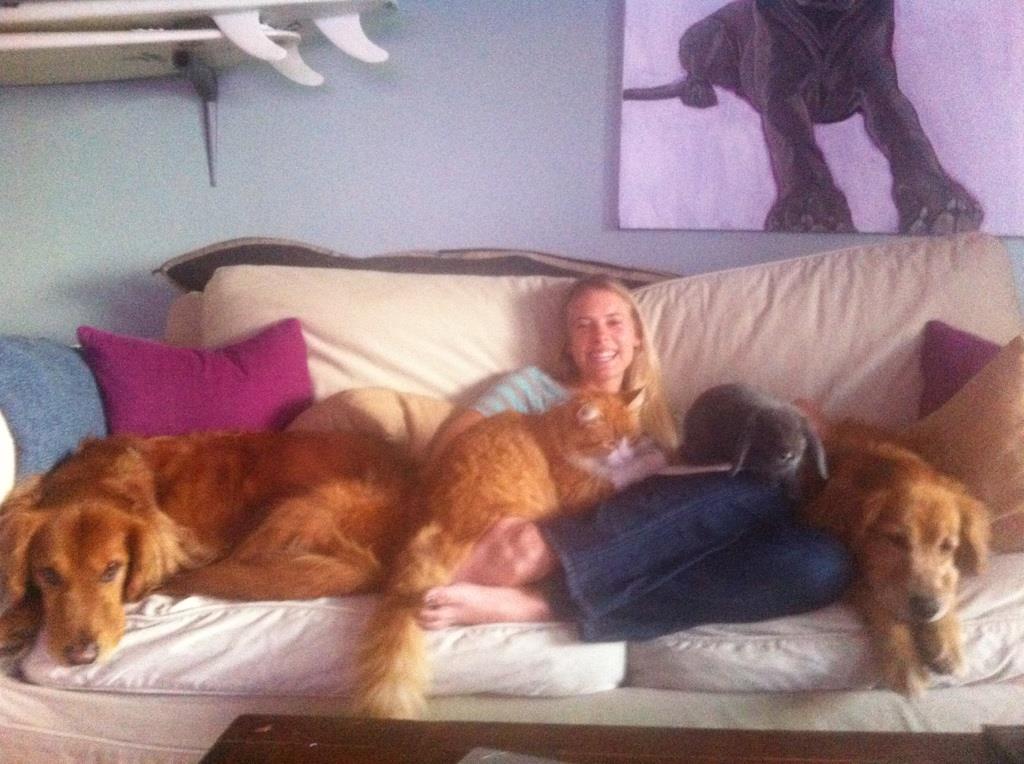
 

Cuddling with all of my animals. Notice the big smile on my face! Pure happiness. 

Our usual cuddle session starts with me sitting on the couch with my laptop, and then Daisy comes over and rests her head on the couch looking at me with her golden eyes asking for approval to jump up next me. I'll ask her if she wants to cuddle and her head stays on the couch while her back end starts wagging. She waits till I pat the couch twice and say, "Up, up," before she hops up and snuggles into my side. She curls up into the cutest little ball or rests her head on my lap. Then Taj slowly lumbers over with his swaying lion's gait, waits for his cue and then curls up into another ball of cuteness.  To top it off, my big orange cat comes over and settles in right on my lap. Squished between my favorite animals on the planet, is pure bliss. My black pants are always accessorized with fur, but I wouldn't have it any other way.
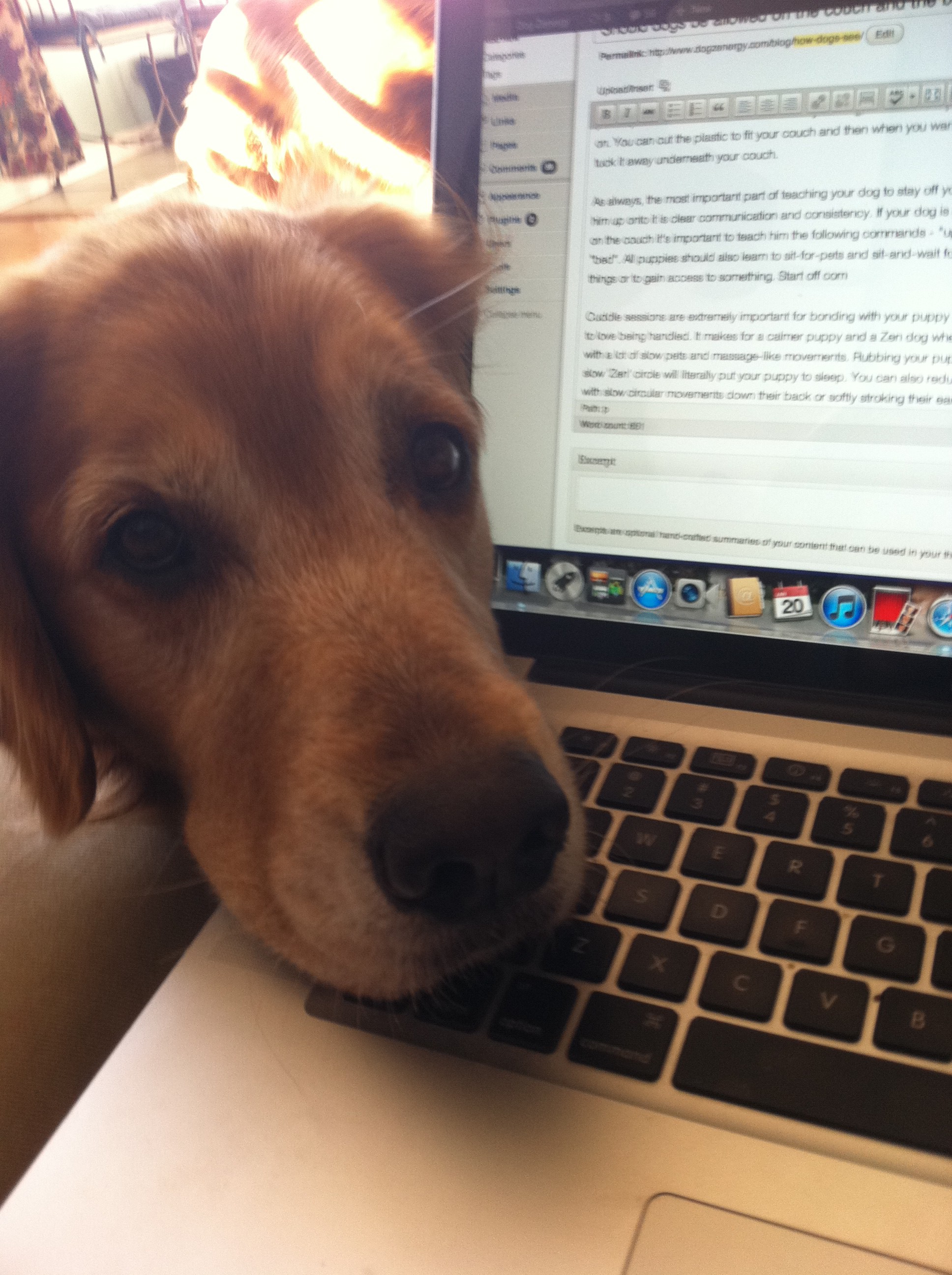
photo-8

Daisy's Can-I-Hop-Up-On-The-Couch Face

That's not to say that everyone experiences pure happiness with animals all over them. Which is why I am a dog trainer who is an advocate for couch cuddle sessions, but only with permission and rules. Any dogs that are allowed on couches and beds must first learn that they are never allowed on a couch or bed. This means that puppies should not be allowed to hop up onto a couch or bed unless they have been placed up on the bed or have been given permission with a cue. Anytime your puppy or dog goes towards a couch and looks like they want to jump up, make an interruption noise and redirect him to his bed. You can also body block them from trying to jump up. Always have a very comfortable dog bed right near your couch and give your puppy tons of praise and pets for choosing to lay on his bed rather than your couch. If your puppy ends up on the couch it's important to make him get off and have him go to his bed.

When you are not in the room with your puppy or when you leave the house, manage your puppy by not giving him access to the room with the couch in it. You can also prop pillows up so that it blocks your puppy from getting onto the couch. Another trick is to use plastic carpet protectors that offices use for rolling chairs. The small plastic points on one side will not hurt your dog, but are merely uncomfortable to lay on. You can cut the plastic to fit your couch and then when you want to sit on it, simply tuck it away underneath the couch.

As always, the most important part of teaching your dog to stay off your couch or to invite him up onto it is clear communication and consistency. If your dog is going to be allowed on the couch it's important to teach him the following commands - "up-up", "off" and "spot". All puppies should also learn to Sit-for-Pets and Sit-and-Wait for permission to do things or to gain access to something. Start off by asking your puppy to sit every time he approaches you while you're on the couch and then give him lots of praise and pets, or drop a treat on the floor by your feet. Keep randomly rewarding your dog with pets or treats for staying on the floor instead of hopping up onto the couch. If your puppy tries to jump up, block him gently or quickly put him back down on the floor. If you have an especially frisky puppy, keep a drag line leash on him and simply step on it to prevent him from trying again.

Teach your puppy to go to his "spot" by luring your puppy onto the bed and clicking when all four paws are on it. Treat your puppy by placing the treat on the bed rather than feeding it straight to his mouth. Then tell him "Ok!" and have him step off the bed. After luring and clicking and treating another three times, point to the bed without a treat in your hand. Click and treat when all four paws on the bed and say, "Good spot!". Once your puppy is starting to gravitate to the spot and is learning the game, attach the cue to your hand signal, by saying, "spot" and then pointing to it. Click and treat once your puppy is on his spot. Keep practicing this exercise and move farther away from the bed as your puppy's understanding increases. Then start asking your puppy to go to his spot while you're sitting on the couch. Practice this for at least 15 minutes everyday with lots of repetitions until your dog thinks that his spot is the best place to be.

photo-9

Taj demonstrating his Zen dog napping skills (on the couch)

Once your puppy grows up and learns that the couch is off-limits, you can train him to jump up onto the couch when given permission. Ask your dog to sit at your feet and then pat the couch and say, "Up, up!" to invite your dog up. Ask your dog to lay down next to you and praise him, then ask him to get "off" by pointing and looking at the floor. If your dog is not getting off, lure him with a treat and click when all four paws touch the ground. Do this three times, and then point and look at the floor while saying off without the treat in your hand. Click and treat once all four paws are on the ground. Also, make sure to drop the treat onto the ground. Make a game out of it by asking your dog to jump up and off the couch several times in a row. It reinforces the good behavior and it also helps to burn off a little energy. If your dog tries to jump onto the couch without your cue, completely ignore the behavior and walk away. If your dog isn't getting the message, leave the room entirely. Your dog will quickly get off the couch and come to you. Withholding the attention and the treat will give your dog the message that he must play by your rules. At this point in the training, you must still manage your dog so that he is only in the room with the couch when you are present, otherwise your comfy sofa may just be too much for your dog to resist.

Whether or not you wish to have your dogs with you on the couch or the bed is a personal decision and whatever you choose, just remember to be consistent. If you let your puppy jump up sometimes without permission and not other times, the mixed message will result in a dog who thinks that the couch is up for grabs. By giving your dog clear, consistent rules, your dog will respect you and your personal space. This way, you will also ensure that your dog does not take possession of the most comfortable spot in the house and make it his. If your dog displays any territorial reactive behavior over the couch, your dog should not be allowed on the couch at all until you are able to completely establish control over the space using clear communication and positive reinforcement. With a lot of clicker training and practice you may be able to one day invite your dog up, but just remember that all dogs that are invited up must be able to immediately get off when asked. All the same rules apply to the bed as well.

Personally, having my dogs cuddle with me on the couch is worth every bit of dog hair and I just love watching my Zen dogs kick their feet in their dreams. My poor house guests probably don't appreciate the hair (little leftovers of super snuggle sessions!) as much as I do and I think my best human friends have learned not to wear black at my house, which is why I also recommend having cute throw blankets on your couch so that you can toss them off when guests come over. A friend of mine has a couch pillow that says, "No outfit is complete without cat hair." Does anyone know where I can get a dog version of this? ; )  332689_10100440811941164_1157620058_o

Happy training!


1 Comment

1 Comment

5 Things I Am Very Thankful For...

My favorite part of Thanksgiving dinner with my family is sitting around the table holding hands and talking about what we are thankful for. Everyone is smiling, laughing and taking a moment to reflect on everything good in their lives. As this year is coming to a close I want to share with you 5 things that I am so very thankful for and I would love to hear what you are thankful for! 1) My family- both furry and non-furry. Family is everything to me and I am so grateful that I have such a wonderful loving family. I have the best mom and business partner in the world. I am so grateful to have her as part of my everyday life. I'm grateful that I live with my big "little" brother who is always there for me. I'm grateful for my dad and his corny sense of humor who showed me what it means to work hard and be brave enough to have your own business. I'm also grateful for my sweet loving boyfriend who loves dogs and all other animals as much as I do and who puts up with my crazy doggy lifestyle. I love my whole family so much and I'm so thankful for each and every one of them. I'm  also so very grateful for all of my awesome friends who are my extended family and for the DogZenergy team who I love like family. I'm so fortunate that all of our DogZenergy team members are so dedicated and so devoted to all of the dogs that we take care of.

2) It goes without question that I am so eternally grateful to dogs for being at the center of my life. Life without dogs would be so sad and empty. My dogs Daisy and Taj mean the world to me and make life worth living! They have taught me more about love, patience, responsibility, playing, cuddling, laughing and living, more than any other creatures. I'm so grateful for my extended family of dogs that we take care of everyday. Working with dogs is humbling, exciting, always different, always challenging and always an adventure. Thank you thank you to all of the dogs that have come into my life because each and every one of them have taught me lessons about people, myself and the experience of living on this planet in the moment.

3) I'm so grateful to live in La Jolla and to be part of such a close, special community for the last 7 years. There's no other place quite like La Jolla. The people who live here are so kind, helpful,  happy and wonderful. I want to thank the people of this community for embracing DogZenergy and letting us be part of their lives. DogZenergy wouldn't be where it is today without the support of all of our loyal customers. I want to thank all of our customers for being more than just clients and for embracing us like family and friends. I've learned so much from all of you and have appreciated all of your stories about life and business. Who needs business school when you have clients that are so willing to help and share their experiences?! Thank you so much to all of you!

4) This may seem cliche, but I'm so thankful for good health and my family's health. As some of you may know my mom had a big surgery a few months ago and she's doing so well now. I'm so thankful that she's living without pain now and that she can start living life to the fullest! I love her so much and I'm so happy that she's feeling better now.

5) I am thankful for every single day and I'm so thankful that my days are filled with dogs, laughter and happiness. This last year has been very challenging both in business and my personal life, but I've learned a lot about the power of the mind and looking at life in a positive light. I love the saying, "Happiness is not a destination, it is a way of life." Learning how to accept the "rough" days as challenges and to embrace difficult things as lessons is a mental practice that involves daily training. Through training dogs, I've learned that I need to actively and consistently train my own mind to stay positive and be responsible for my own happiness. I've found that being grateful for all of the things in my life on a daily basis is the best training exercise for a happy mind and a happy life.

A huge thanks to all of the DogZenergy dogs and their amazing humans! Happy Thanksgiving!

1 Comment

Comment

The 4 Noble Truths of Dog Training

Whenever I think about dogs being "Zen" for some reason I think about a really mellow, pudgy pug sitting up with his Buddha belly hanging out and his little legs stretched out in front of him. It makes me smile when I think of such strange things. Today, I've also been thinking about Zen Buddhism's Four Noble Truths and how these principles can be applied to dog training.

In his book, The Four Noble Truths, Tashi Tsering Geshe explores the foundation of Buddhism by taking a closer look at the truths by which one can follow on their path toward enlightenment. They are as follows:
1) The truth of suffering
2) The truth of the cause of suffering
3) The truth of the end of suffering
4) The truth of the path that frees us from suffering

Comment

Comment

What is a good dog?

241041_10150269406356397_122377471396_9349885_8080557_o

What is the definition of a good dog? According to the Merriam Webster Dictionary, a good dog is defined as follows:

Good (adj.) 1) of a favorable character or tendency 2) agreeable or pleasant 3) suitable, fit 4) well-founded, cogent 5) adequate, satisfactory 6) virtuous, right, commendable 7) kind, benevolent 8) competent, skillful 9) loyal 10) free from sorrow or infirmity

No wonder the word "good" is dog spelled backwards with an extra "o" in it. Dog (n.) 1) A highly variable domestic mammal closely related to the grey wolf 2) A worthless or contemptible person 3) An unattractive person; especially: an unattractive girl or woman

First off, I think the third definition for the word dog is highly offensive because I only wish to aspire to the greatness of a dog. Secondly, this definition does not even capture the depth and meaningfulness of what it means to be a dog. And finally, if Merriam Webster is reading this right now, I think you guys need to revise the definition to be more like this...

Dog (n.) 1) a highly intelligent, intuitive, social domestic animal that comes in many shapes, sizes and colors 2) a loyal friend 3) an adventurous companion 4) a soulful creature who is capable of teaching people a lot about life, love and happiness 5) a working animal who's biggest job is being a human being's best friend 6) a highly motivated animal who will work for food, toys, attention and praise 7) a sensitive animal who will never forget being mistreated 8) an animal who deserves to be respected and appreciated 9) capable of learning over 200+ words/commands 10) has over 100 million olfactory cells in its nose 11) sees color on a blue to yellow spectrum, does not see reds, sees a lot of grey 12) has exceptional hearing 13) loves to play, sniff, run, romp and roll 14) loves to sleep and eat 15) loves to love people

I always ask clients what their idea of a good dog is before we start training their dog. Yes, we all want to have a good dog, but it's so important that we define what that means. Do you want your dog to have a reliable recall? Do you want a calm dog who greets you at the door without jumping? Do you want a dog that keeps their paws off the counter? A dog who brings you your slippers in the morning? A dog who stays when you ask him to? Etcetera. It's important to break down all of the specific "problems" that your dog has so that you can start learning how to effectively train and manage your dog to modify his behavior. Most importantly, it's very important (very important) to visualize your dog being a good dog and then look for and positively reinforce any and all good things that your dog does. Human nature tends to have a negative bias and we are very good at giving a lot of attention to bad things. Train yourself to look for the good in your dog and your dog's behavior will immediately start to change all around. Sometimes I think using a clicker to train animals does as much for the human as it does for the animal. It trains people to look for the good behavior in order to give a click for it. Write down all of the "bad" things that your dog does and then re-write it in a positive light. For instance...

I hate it when my dog pulls on the leash I love it when my dog walks loosely on a leash by my side

I don't like it when my dog begs for food I love it when my dog lies at my feet at the table in a down/stay

Then write down your own definition for a good dog. This is my definition...

A good dog is a happy, trained, attentive, balanced, calm, loving, playful animal who follows all of my expectations, boundaries and rules. A good dog waits and looks patiently at me for my cues to allow him to enjoy all of the good things in his life. A good dog is calm and mellow who is happy to lay around all day by my feet knowing that he's going to have play time and exercise in the morning and evening. A good dog can be safely trusted off leash and will reliably come when called and leave things alone when I ask him to. A good dog will follow my benevolent lead based on trust and communication rather than physical and emotional intimidation and aversives. A good dog is a cuddle bug. A good dog can be trusted to be non-aggressive and confident around all people, kids and other animals. A good dog is calm and non-reactive around loud noises, strange objects and new places. A good dog can be left alone in the house without being crated and can be trusted to not make a mess or chew things up. A good dog is quiet and Zen. A good dog is enjoyable to be around and is an absolute joy to spend the best and worst moments in life with. A good dog makes all of your troubles and worries melt away and teaches you how to play and enjoy life. A good dog teaches you how to love everything and everyone unconditionally.

What's your definition?

Comment

Comment

Five ways to teach your dog to come when called!

Teaching your dog to come to you in any situation is one of the hardest things to teach a dog to do reliably. The reason why it’s so tricky is because it’s so hard to train ourselves as humans to consistently positively reinforce our dogs when they do come over to us. Humans are very busy creatures who are always trying to get from point A to point B very quickly. Dogs are very happy animals because they love to soak in the sights and smells of the moment. We don't find as much joy in smelling lamp posts or spending another twenty minutes at the dog park, and we want our dogs to come right away. If they don't come right away, people get really frustrated and end up calling their dogs over and over again. They start to yell more and more and then once their dogs finally do come, they're so frustrated with them that they may end up swatting them or giving them a big jerk on the leash. Nobody wants to run right over to a person who's a jerk. Instead, you want to teach your dog that coming to you is the best thing in the world, because you may one day even save your dog from a dangerous situation. A reliable recall is the most important command that you can teach your dog. Here's how to do it...

1) When first teaching your dog to come, never call your dog over to you when he is engaged in play or very interested in something smelly and wonderful. You will get ignored and then you will keep calling him and then he will learn that come basically means nothing to him. You might as well be yelling at the top of your lungs, "Keep ignoring me!". Instead, wait until your dog has lost interest in the present distraction, and then capture your dog's attention with an interrupter "kissy" noise and big hand motions. Once your dog looks at you and has taken one step towards you, call him over to you while waving your hand above your head and take a few running steps away from your dog. If you walk towards your dog, he will think that you are following him and he will continue to move away from you. By running away from your dog, he will think that you're running somewhere to have fun without him and then he'll want to get in on the action too. When teaching your dog to come to you, it's very important to always have a reward ready for when he comes to you. Once your dog is reliably coming to you, you can start using the variable ratio method, meaning that you only reward him sometimes and only for really quick and snappy 'comes'. It's also important to vary the different types of rewards and to use a very high value reward (think hot dog pieces or cheese) when faced with big distractions.

2) Call your dog to come for anything and everything good. Meaning, call your dog when it's dinner time, when it's time to go for a walk, when it's time to play, when it's time to cuddle, when it's time for a car ride, etc. Always call your dog consistently and constantly the same way. You should always say your dog's name first and then "come" or if you prefer, "here". So for instance, if your dog is in the other room, randomly pick up a toy and hide it behind your back, then call him over to, "Bruno, come!" and once he comes over to you and sits in front of you, give him the toy you've been hiding.

3) Using a 15 ft long line, a clicker and treat bag full of goodies, have your dog sit and then call your dog to come to you. Then take several fun running steps backwards. The second that dog takes a step in your direction, click and then treat. If you click and treat when your dog approaches you and sits, then he may think that he is getting rewarded for sitting. Also, by clicking right when your dog makes a move, it will make him come over to you much faster. Keep calling your dog while moving around with big, fun, erratic motions. Think of it as a fun game because you want your dog to think that coming to you is the best thing in the world. Be sure to end the game before your dog loses interest in the game to make sure that you're building his drive and motivation.

4) Playing Hide-and-Go-Seek with your dog and a friend will also build up your dog's motivation and willingness to come to you. Have your friend hold onto your dog while you go hide in another part of the house or yard. Make it easy the first few times and then call your dog to come to you. Once he races over to find you, give him lots of praise and a treat or toy. Then hold onto your dog and have your friend go and hide. This game will not only teach your dog how to reliably come to you, but it will also build up your dog's confidence when he finds you and it's a great way to burn off your dog's mental and physical energy.

5) Be very mindful of not calling your dog to come to you when something unpleasant is going to happen to him. For instance, when it's time to clip his nails, clean his ears or come towards anything that your dog is fearful of. You want the command for come to mean that great things are coming to him once he reaches you. If something negative happens, you will be decreasing the behavior and the effectiveness of the command. When your dog is playing at the park, teach your dog to check in with you when you call him over to you and then reward him by telling him to "go play" again, but never put him on his leash and leave when you call him. Instead, just walk over to him when he’s taking a break or getting water and then snap his leash on him. It’s also always good to keep a goody stash in your car with lots of different kinds of treats and toys so that you can give your dog something great when you leave the park. Your dog will want to leave if he gets a goody every time. Same thing goes for at home when you call your dog inside when he's been playing outside. Make sure that the fun doesn’t end when you call him in and then be sure to give him a treat or toy when he comes inside. If you do this consistently when your dog is young, he will have a very reliable recall when he is older.

Most importantly, never ever get frustrated or mad when your dog doesn’t come right away. Nobody wants to hang out with somebody who they can't trust. Always exercise great patience when dog training. Dogs who have very calm, confident and benevolent owners have great recalls. They know that their owner isn't going to punish them for coming over to them and they also know that they just might get a jackpot of good things. Be the happiest human ever and your dog won’t want to leave your side. The happier you are, the faster your dog will start coming to you.

Comment