

|
"A dog is not considered a good dog because he is a good barker. A man is not considered a good man because he is a good talker." ~ Hindu Prince Gautama Siddharta, the founder of Buddhism, 563-483 B.C
Actions speak much louder than words, especially for dogs. Just remember, you can say more to your dog by using clear body language and being consistent than you can by using a lot of words over and over again with no actions. Train your dog to be a good Zen dog by learning how to use your own body language clearly and by being consistent with your intentions. One study shows that 90% of human communication is made up entirely of body language, with the rest being oral language. For dogs, 99% of communication is through body language and a mere 1% is oral. |
|
One exercise to try with your dog, is to run your dog through all of his commands without uttering a single word. You will be pleasantly surprised to find that your dog will know exactly what you're "talking" about. Take your dog for a silent walk with the intention to observe his body language with you and with other dogs, then make the conscious effort to "watch" your own. Do you shift your weight, tilt your head, use your hands, rest on your hip, crouch down or step towards your dog when you ask him to do different things? What works and what doesn't? Are you smiling, nodding, making eye contact, petting, or acting happy? Does your dog look at you more when you are happy? Your dog is an expert in reading your body language, therefore it is extremely important that you are conscious of the way that you are using it. Oftentimes, in training sessions, I have to remind the dog's human to watch my body language rather than just staring at their dog. It's not that I have a big ego and I want people to stare at me (awkward!), but if the owner is not watching to see what I am doing to get his or her dog to respond the way that I want them to, they will be missing out on the key component of the training process. Little kids are much easier to teach when it comes to dog training, because they are much more used to watching and mimicking adults' body language. |
|
Be mindful of the information that your body language is portraying and change it if you are not getting the results that you want. Be mindful of the thoughts that you have because they will be read all over your body language. For example, if you are trying to work on your dog's negative reaction to other dogs while on leash, be very careful about how you think about seeing other dogs, otherwise your body language will follow- sucking in your breath, clutching the leash, pulling your dog back- which all contribute to an increased stress response for your dog. In the words of Buddha, "The wise have mastered the Body, words and mind. They are the true masters." |
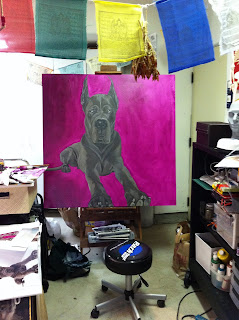
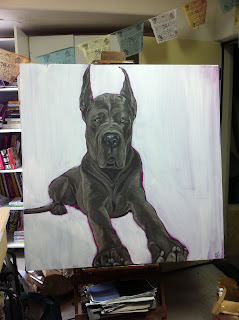
There is nothing better than a paintbr
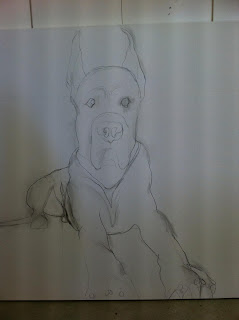
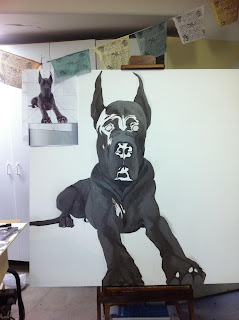
ush in my hand, the smell of oil paint and the relationship that I create with each and every dog that I paint. After staring at these beautiful faces of Zen dogs for hours and hours, it's hard to get them out of my head. I wake up in the morning thinking about all of the different colors and shapes and shades that dance around in my brain. How wonderful is it that a painting of a dog or a
human or an apple or whatever is, is just layers of different pigments that create the im
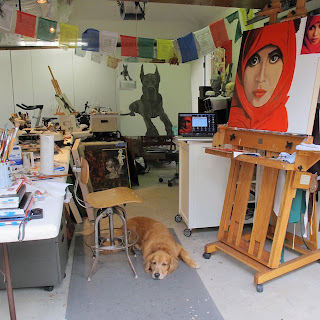
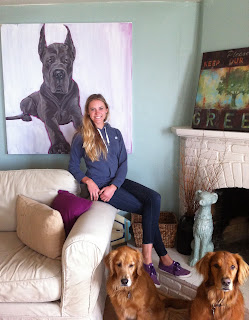
ages, feelings, and thoughts that our eyes absorb? How fun is it that our hands can create something so 'real' on such a flat surface? I find painting to be so fascinating, challenging and so entirely engrossing that it makes me so completely happy! The best part about an afternoon painting with my good friend, artist and teacher,
, is having our dogs lay by our feet in Becky's amazing studio. My dog Daisy is such a happy girl when her dog mom is happily painting. It's s
o much fun to do something tha
t you love to do with your dog right next to you. Becky and her dog Murphy meditate together every morning. Murphy s
tretches out on his side completely relaxed, happy and at peace. Enjoy each other and enjoy what you do because every moment is so precious!
Dear Zen Dog Girl,
This is Danielle (Wally's mom) we were in your puppy class almost a year ago now. We are close to moving into a house and once we do we would love to schedule individual training sessions. I really want to teach Wally that the street is a bad place. He is very good about staying close to me, but if he were to ever get out for any reason I am very scared he would go in the street. My brother in law lost his puppy about 6 months ago in the street because the landscaper opened the gate. We will definitely be extremely careful, but as a part of that I want to spend more time doing training with Wally.
However, the reason I am emailing you tonight is because Wally has developed a new fear. Any time we make a crackling noise he runs like the wind into the closet and hides in the hanging clothes. When we cook something on the stove, open a bag, or crack our knuckles he runs in there. He also does it when we put his food in his bowl, even if we try to do it quietly.
I am not sure what has spurred this behavior because we have only seen it for a week or two. Several months ago (about August or September) I roasted vegetables in a glass Pyrex dish, but I accidentally placed it on a hot burner, and it exploded all over the kitchen. We are thinking that may have scared him- but he has not been so scared of these little noises until recently. He is terrified of fireworks and thunder, which is understandable and we keep him away as best as possible. I am just baffled by this fear of opening a chip bag or his food bag, or cracking knuckles. Some noises, like opening a soda can he is not scared of. I hope you have an idea of what we can do to help him because he runs into the closet more than 10 times a day, just by us doing our normal things.
Thank You!
Danielle, Steve, and Wally
Hi Danielle, Steve and Wally!
So good to hear from you! Sounds like poor little Wally does need some therapy! We can set up a training session for whenever you like. In the meantime, here are a few things that you can start doing immediately. Begin by desensitizing and conditioning him to very "quiet" noises. It takes a lot of patience and time to desensitize dogs to scary, stressful stimuli, but Wally is still young and you are the perfect owner to work with him because you are patient and willing to do what it takes to make him confident and happy. Follow these three steps and Wally will be loving snap, crackle, pop noises before you know it!
Step 1: Even though it may be tough, resist all urges to coddle, cradle, pet and/or coo, "It's okay Wally!". It's our natural reaction to want to comfort our dogs when they are scared, but doing so gives them lots of attention for the behavior that they are displaying. When Wally is scared, he finds comfort by escaping into the closet and then probably waits for you to follow him there and tell him that 'it's okay' to act that way. His behavior will be positively reinforced if he gets attention for this. You want to make sure that you don't give any attention to his scaredy cat behaviors and you never ever want to follow him to the closet so that he can learn that tiny little noises aren't going to kill him. Also, make sure to observe your own reaction to a noise. By this time you have also probably been trained to hear a certain noise and then unconsciously look over at Wally worried that he will have a bad reaction to it. This small act may even be cuing him to react fearfully. Make sure that you always smile, be calm and be confident. When Wally doesn't display any fearful behavior to a noise, you can give him all of the love and attention in the world!
Step 2: Learn to recognize his threshold or tolerance levels to certain noises and then set up situations to work with him slowly by using clicker training. For instance, take a piece of paper, crinkle it a little bit and see what his reaction is to it. If he isn't startled, this is a good thing. You don't want to stress him out at all at this point. You want to start with a noise that he is very tolerant of and then build up the loudness based on his progress. If the piece of paper crinkling doesn't set him off, crinkle it, set it on the floor, and if he steps forward to investigate, you will click the second he takes his first step and then treat him by dropping the treat away from the paper so that he has to turn away from it. When he returns to investigate it again, click and treat away from the paper. Then crinkle the paper again and drop it on the ground. When he steps forward towards it, click and treat again. Keep doing this until he is able to walk all the way up the paper. Attach a cue to this, by saying, "check it out". Then you will be able to slowly increase the intensity of the noise by doing this type of exercise with other items that make noise. Make sure that you do not 'up the ante' too quickly and that you only proceed if Wally's body language is calm and happy. Look for good eye contact with you, tail held low and wagging, ears forward and not back. There should be no wincing, backing away, tail tucking or nervous signs like excessive panting, salivating or yawning. Set him up for success and just do a few repetitions a couple of times a day. You will have more success with several 5-10 minute training sessions spaced out throughout the day than you will with an hour long one once a day.
Step 3: Once Wally is feeling comfortable and confident with the slightest noises, start walking around your house making small noises like a small snap of your fingers, lightly setting a book on the table, touching a plastic bag etc. and randomly make the noise and happily say, "check it out!". Then nonchalantly drop several high value rewards (pieces of chicken, cheese, or any type of super smelly, yummy, soft treats) at your feet. Keep your treat pouch on you at all times around the house or place treat jars strategically around your house where you can easily grab some. Also, whenever you hear a noise that you know Wally is comfortable with, praise him and give him lots of attention for not reacting to the noise. Also, practice your basic commands (sit, down, look, touch, stay, leave it, go to bed, crawl, back etc.) with him everyday for at least 15 minutes. Get creative and play games with him or teach him a new trick everyday. Ask Steve to make a few quiet noises in the background while Wally is preoccupied with you playing the games. Build up his confidence all around and pretty soon Wally will be running towards noises!
It's great that you want to street train Wally and we will easily be able to teach him this during our session together. Go ahead and check out my article "
Doggy Street Smarts in 7 Steps
" for some helpful tips in the meantime. Looking forward to working with you more and I can't wait to see Wally's progress! Happy training!
Peace, Paws, and Love,
Zen Dog Girl : )
Update:
Thank you so much!!! We have been working with him the last few days and Wally is doing much better. Still nervous but he hasn't run into the closet at all! Thank you very much for responding! We will hopefully schedule a time with you very shortly!!!
Happy new year!!
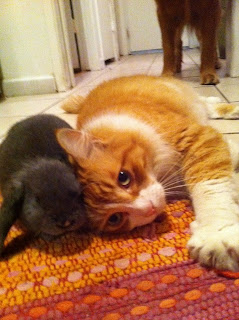
Living with two golden retrievers and a big orange cat is a recipe for lots of dust bunnies living in every nook and cranny of our house, so making the decision to bring a real live bunny into it seemed only natural. Last week we brought home Bob the bunny and now our lives are enriched with lots of cuteness, bunny poops, laughs and constant entertainment.
I'm not going to lie, I was pretty nervous at first about introducing Bob to my dog Daisy. Daisy has a high prey drive and has been known to chase a squirrel or two. However, with clicker training, the proper setup and a few positive training sessions, it's more than possible to have a peaceful, multi-species household. The first step to introducing new animals into a household is to "manage" the situation safely. Your bunny (or cat), should always have they're very own space that your dog cannot get into that is dog-proof. Bunnies can stress out very easily so it's important to have a place for them where it's quiet and free of other animals. Next, make sure that you have an exercise pen so that you can have an area where you can sit with your bunny with your dog on the other side. You must also have a clicker and a pouch full of carrot shavings. Luckily, my dog Daisy loves carrots as much as Bob the bunny does.
The first part of the training process is to teach your bunny what the clicker means. My goal is to teach Bob how to come when called, put two feet on my leg when I'm sitting, jump up into my lap, stand on his back legs, and go to a book and sit on it. These tricks are easy for bunnies to learn if you're using a clicker. I first taught him how to follow my finger, by clicking every time he hopped towards my finger to investigate it. Then I would take a piece of carrot out from behind my back and offer him a nibble. After one nibble, I'd put it back behind my back and then repeat the process. As soon as he started to reliably follow my finger and recognize that the click means he gets a nibble of carrot, I was able to attach the cue, "Come Bob!". In the meantime, as I was clicking and treating Bob, I had Daisy in a down/stay by my side on the other side of the cage. Every time that Daisy seemed disinterested in Bob, I would drop a piece of carrot between her two front paws. This was not as easy to do as it sounds, because Daisy was so obsessed with Bob that she would whine non-stop. It took a good fifteen to twenty minutes of down stays before she stopped whining and intensely staring at little Bob. For three days, the three of us sat on the floor a couple of times a day getting to know each other very well. Bob LOVES carrots and will do anything for clicks and nibbles. Daisy has learned to LOVE Bob because Bob means carrot time. It's a case of classical conditioning at it's best.
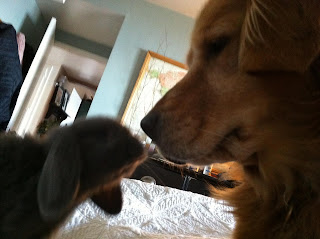
Once your dog has learned to "lose interest" in the bunny and once your bunny seems more comfortable with your dog, you can hold your bunny in front of your dog's nose and let your dog smell the front and back of him. Make sure that you tell your dog to sit and stay before you do this. You must always be in control of the situation byconstantly telling your dog what to do. If not, your dog will do what he naturally wants to do, which might be to eat the bunny. Tell your dog, "gentle" and if your dog gets too aroused simply take the bunny away and go back to working with your dog and bunny with the safety of the exercise pen. If your dog stays calm, let him investigate the bunny more. It's important to not let your bunny down at this point, because if your bunny runs away, your dog's natural instinct will be to run after him. Also, make sure that you do not restrain your dog by the collar and/or with a leash. Restraining your dog will only create more frustration toward the bunny. Keep your training sessions calm, happy and stress free.
After a couple days of desensitizing Daisy and teaching Bob what the clicker means, I was able to put Bob on the floor in a small room with Daisy and I. You can use your bathroom or a blocked off kitchen. Have lots of carrots and/or high value dog treats on hand for this big moment. Ask your dog to sit and stay and treat your dog profusely for staying put and for not intensely staring at the bunny. If your dog can't take his eyes off of him, you're definitely not ready for this step yet. You should be able to get your dog's attention easily and he should be happily staring at you waiting for his treat. It's okay if your dog casually glances at the bunny, but no staring allowed. Also, if your dog is food aggressive at all, it's very important not to do these exercises with your dog and the bunny without a fence to keep the two of them safely apart. After a few 15 minute sessions each day for two days, Daisy was completely bored of Bob and now lets Bob run and poop all over the house. Once I figure out how to potty train a bunny, I'll get back to you on that!
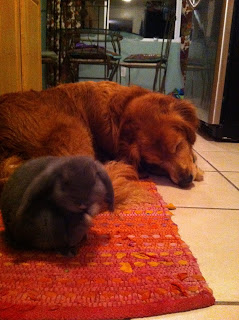
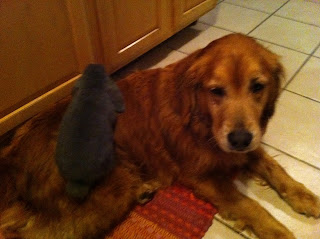
Today, we were all cooking dinner in the kitchen and Daisy, Taj and Bob were all laying at my feet patiently waiting for their scraps of carrots and broccoli. I couldn't believe my eyes when Bob hopped up onto Daisy's back and just sat there. Daisy just looked at me with her head on the floor probably thinking, "Seriously? A bunny? On my back? I better be getting two carrots for this."
Happy training!